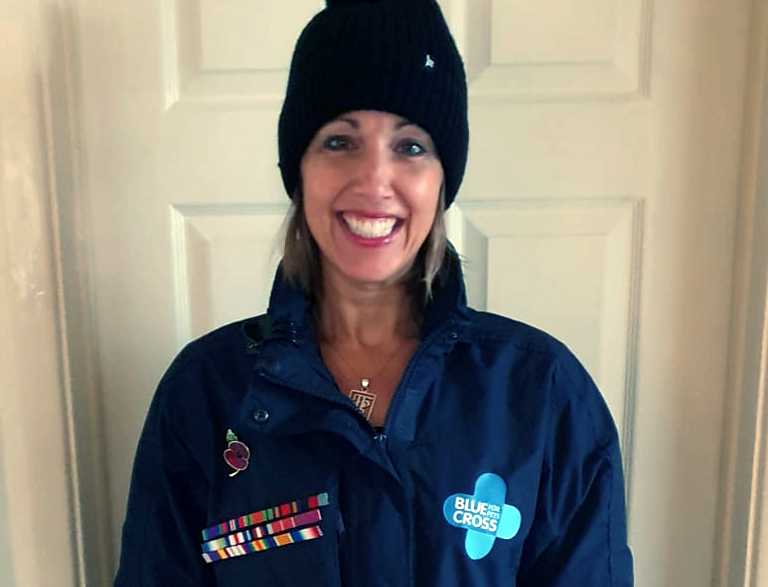
Author
John Qualtrough
Branch
Royal Air Force
Personal Stories
This story of Flight Lieutenant Joseph M Qualtrough was prepared by his son John with help from sister Josephine, brother Terry and sister-in-law Gill, recounting "things our Dad and Mum told us", plus archive material
Joseph Mylchreest Qualtrough (Joe) was born on 9th November 1914 in Ballasalla, Isle of Man. He did well at school and later gained BSc(Hons) at Manchester University in Electrical Engineering. He joined the Isle of Man Electricity Board, where he was well established as a Chartered Engineer when WW2 began, but it was not long before he decided to volunteer for the RAF. He was sent to RAF Cranwell to train as an officer.
When he arrived there in May 1941 he was told that a young woman from the Isle of Man was also training as an officer there. And so he met Nora Smallbone. She was not actually from the Isle of Man, but she was resident there when she volunteered for the WAAF. Her father was in the Royal Navy posted to anti-submarine duty in the Irish Sea, and he had decided to move the family there from their home in Portsmouth, which was being bombed heavily. Their relationship developed and they went around together in an Austin 7 car he had bought for £5 - as much as petrol rationing and wartime restrictions allowed.
He had some involvement with the Home Guard - maybe as a spare time activity - and said it was just as depicted in Dad's Army. Leaving Cranwell in November 1941 as a Flying Officer he was told he would be posted to a training unit in Lincolnshire, to which he said "That doesn't sound very interesting", which drew the reply "Oh, you want something interesting, do you?". So he was posted to Burma. He then realised it was not wise to question a posting.
He said he sold his Austin 7 for some packs of cigarettes. He and Nora married on 29th November 1941, and two weeks later he was on a troopship in the River Clyde - waiting for a gale before putting out to sea, because submarine attacks were less frequent in rough weather.
The morning after they started out there were only three out of 300 at breakfast in the officers' mess - of which he was one, as fortunately he was well accustomed to being at sea. On the voyage out the troops were briefed on things to avoid – such as shaking out their footwear in the morning in case scorpions had climbed inside, and keeping away from snakes. On his first morning in Burma Joe shook out his shoes – and out dropped a scorpion. On another occasion he went in to the bathroom to be confronted by a rearing cobra. He tried to shoo it out with his stick but it shot past him with lightning speed, and he felt lucky it didn’t stop to bite him.
His job was to organise wireless communications between units and services, and we believe he was attached to a Gurkha Regiment for at least some of his time there. But the Japanese had taken control of Burma, pushing the Allied forces into North-eastern India.
In India he was appointed CO of a RAF Communications base, with the rank of Flight Lieutenant. He had several bouts of tropical fevers and infections, and in May 1944 was diagnosed with TB, By July he was seriously ill and sent to hospital in Calcutta, and then in November was moved to a new military hospital called Baragwanath in Johannesburg, South Africa.
In recent years his daughter, Josephine, went to South Africa with her husband, Roy, and they were allowed to visit Baragwanath hospital. They met the current TB specialist who told them that, at that time, men with TB were put out on the veldt (field) when they arrived. If they survived, they were moved to a ward to receive treatment that might enable them to recover.
At Baragwanath Joe had one lung removed and his phrenic nerve was cut in the process, which left his diaphragm inoperative, such that his breathing capacity was very low from then on. He said there came a time when he realised that his bed had been moved into a ward for people who were expected to die soon, and he decided that he wasn't going to die. He had a lot of psychological strength.
In later years he would often say that the best part of his life education was spent lying on his back in a military hospital - and that it takes real character to do nothing successfully! A while after the war had ended Nora was able to go out to South Africa by ship - and introduced him to his daughter, Josephine, who had been born in September 1942.
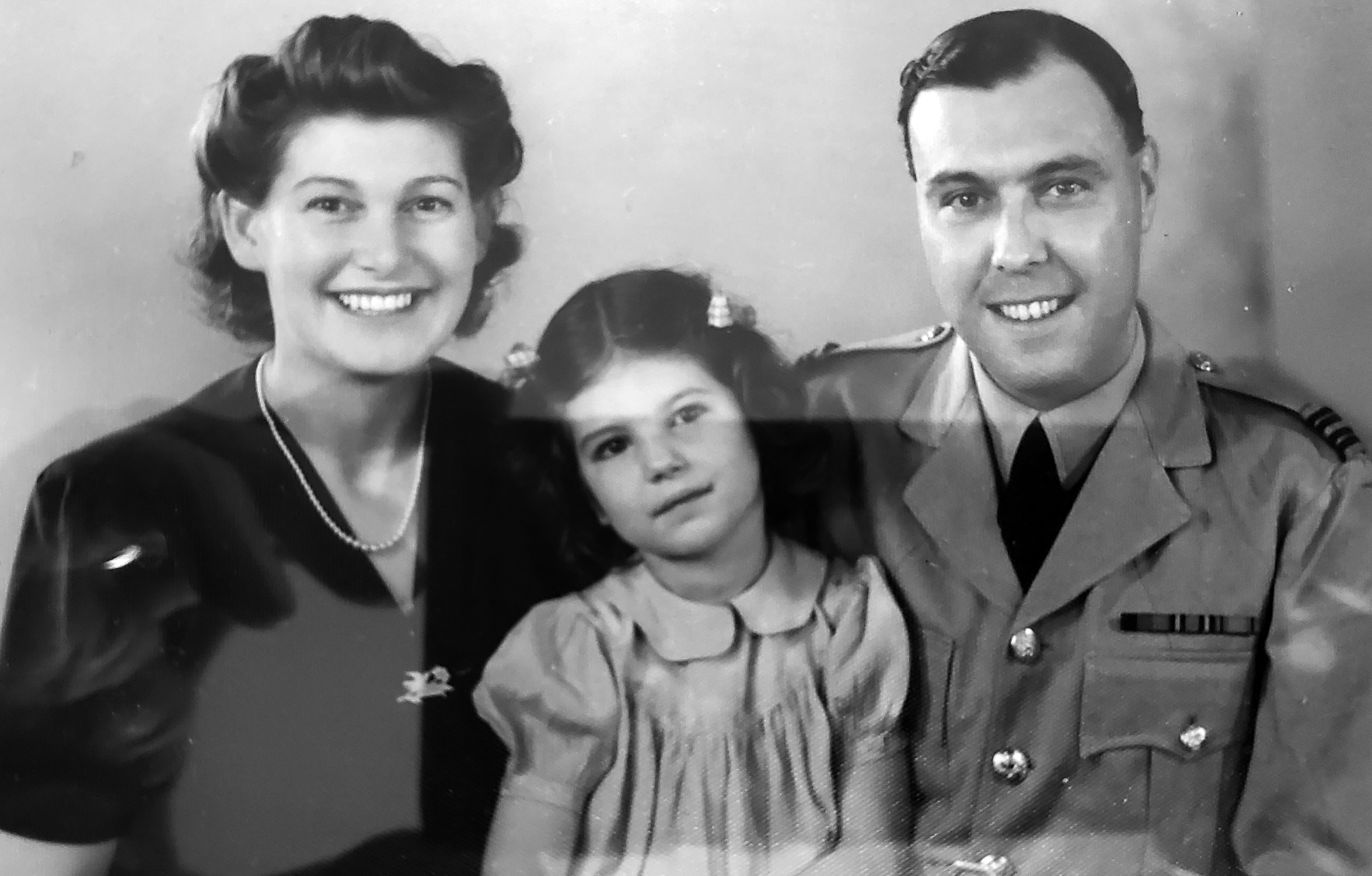
This was arranged by the MoD who also arranged nice accommodation near the hospital, and Joe was able to visit them there when he had recovered sufficiently. They weren’t allowed to go inside the hospital because of the infection risk. The photograph above shows Joe with Nora and Josephine in South Africa. Their company must have helped his recovery a lot, and in February 1947 son John was born.
A few weeks after that the King visited the hospital accompanied by the Queen and Princesses. Joe was awarded the Burma Star. He and Nora contemplated staying in South Africa, but decided to return to the UK later that year. He was obliged to relinquish his RAF commission in October 1947 as his health was below the required medical standards for future service, and received the King’s Badge for disablement on active service. He was demobbed
with a 100% disability which was reduced to 75% then finally 50% as his recovery progressed. He said it was often difficult because he looked quite well, and many people didn't accept the extent of his disability. After a further period in a Nursing Home the family moved back to the Isle of Man.
Before joining up he had understood that he would be able to return to his old job after the war, and was disappointed that it didn't happen. But he returned to work at the Electricity Board nevertheless, and had a successful career there, eventually being appointed Assistant Chief Engineer.
He had been a keen sportsman pre-war but was unable to continue that. However he was as active as his limited breathing allowed. He was a leading member of his church, and lectured in Electrical Engineering at the local Technical College in his spare time. His second son Terry was born in 1951.
In 1971 he had a recurrence of TB, perhaps triggered by the tragic death of Nora, but it was treated quickly with the help of streptomycin. He was surprised to make it to the age of 70, but died a few months after that on the 16th of April 1985.
His granddaughter Katherine Qualtrough, pictured below, wore his Burma Star, along with other family medals, at the Cenotaph parade last year.