
Author
Steve Fogden of the Chindit Society
Branch
Army
Personal Stories
In early October, the Chindit Society was pleased to receive the following enquiry from Steven Brownhill:
"My father Mons Brownhill, served as a Chindit with the 2nd Yorks & Lancs and I would appreciate any assistance or advice as to how I could find out more about his deployment with the Chindits. I have a copy of his Army service records and he did mention that he flew in by glider on a mission to blow up a railway line. West African trackers were part of his group and after splitting up and heading away from the railway they ran out of rations and water and ended up squeezing water from the moss they noticed growing on the track they were marching along. He once told my sister that he was held by his feet over a stream to reach down for water, being chosen because he was the tallest in the group."
From the service records provided and other papers held online, it was quickly confirmed that Mons Brownhill, who was born on the 11th April 1915, had enlisted into the British Army in June 1940 and had served with the Yorks & Lancs Regiment throughout, until a posting to the 2nd Battalion had seen him voyage to India in early 1942. By late 1943, the 2nd Yorks & Lancs were part of the 14th British Infantry Brigade and were training for the second Chindit operation in the scrub jungle near the Indian city of Rajgarh.
As some readers may already be aware, in late 2024, new Chindit-related files began to be released by the India National Archives in New Delhi. Amongst these were a few pages about the lesserknown Chindit unit, Bladet Force. On the nominal roll for those men who comprised Bladet Force was Pte. 4755813 Mons Brownhill. A clue as to how Mons ended up with this specialised unit came from the History of the 2nd Battalion, The Yorks & Lancs Regiment, written by Lt-Colonel Graves-Morris DSO, MC:
On the 12th December 1943, Lt. Walter Dransfield Hampson Taylor (known as Tiger and formerly of the East Lancs Regiment), who had been the enthusiastic commander of 84 Column Reconnaissance Platoon, was ordered to join 4 Corps with ten specially picked other ranks, to obtain information that would be invaluable to the battalion for operations (in Burma), and therefore the very best men should be selected. As so frequently happens and in spite of many appeals, Lt. Taylor and his party did not rejoin (2nd Yorks & Lancs), but operated with a special force named Bladet in Burma.
Bladet Force was a self-contained Chindit unit, led by Major Robert Blain DCM, a Royal Engineer soldier who had served alongside Mike Calvert on Operation Longcloth. He had performed so well in 1943, that Wingate had promoted him from the rank of Company Sergeant-Major to Major and handed him his own unit for the second expedition in 1944. Bladet was made up of 5 officers and 50 or so men, mostly sourced from other Chindit Reconnaissance and Guerilla units, including from the 2nd Duke of Welington’s, the 1st Essex and the 3rd West African Brigade. These were supplemented by a section of Royal Engineers and five muleteers and their animals. Sent into Burma on the moonlit night of the 18/19th March, and landing in gliders piloted by men from the 1st Air Commando, (USAAF) onto a hastily constructed landing strip on paddy fields close to the Irrawaddy River, Bladet Force were tasked to blow up and disrupt the Mandalay – Myitkhina railway line in the area around the Burmese town of Wuntho and suggest that the Chindit zone of activity in 1944 was much wider than it actually was.
Pte. Brownhill and the other men from the 2nd Yorks & Lancs flew in aboard Glider No. 2 piloted by Lt. Johnson and 1st Lt. Carwin Miles of 1st Air Commando alongside four other soldiers from the Royal Engineers. Major Blain was injured on landing and was eventually sent back to base by light plane along with the five USAAF pilots, leaving behind his second in command, Lt. Stewart Binnie (2 DWR) to command Bladet Force in the field. The force immediately marched from the river through a dry belt area which was very tough going. They were tracked for a time by men from the Burma Traitor Army, but did not come into contact with any Japanese during their time operating in the area around the railway corridor. They succeeded in blowing up the railway in several places and also destroyed a small bridge and a large water-pumping station.
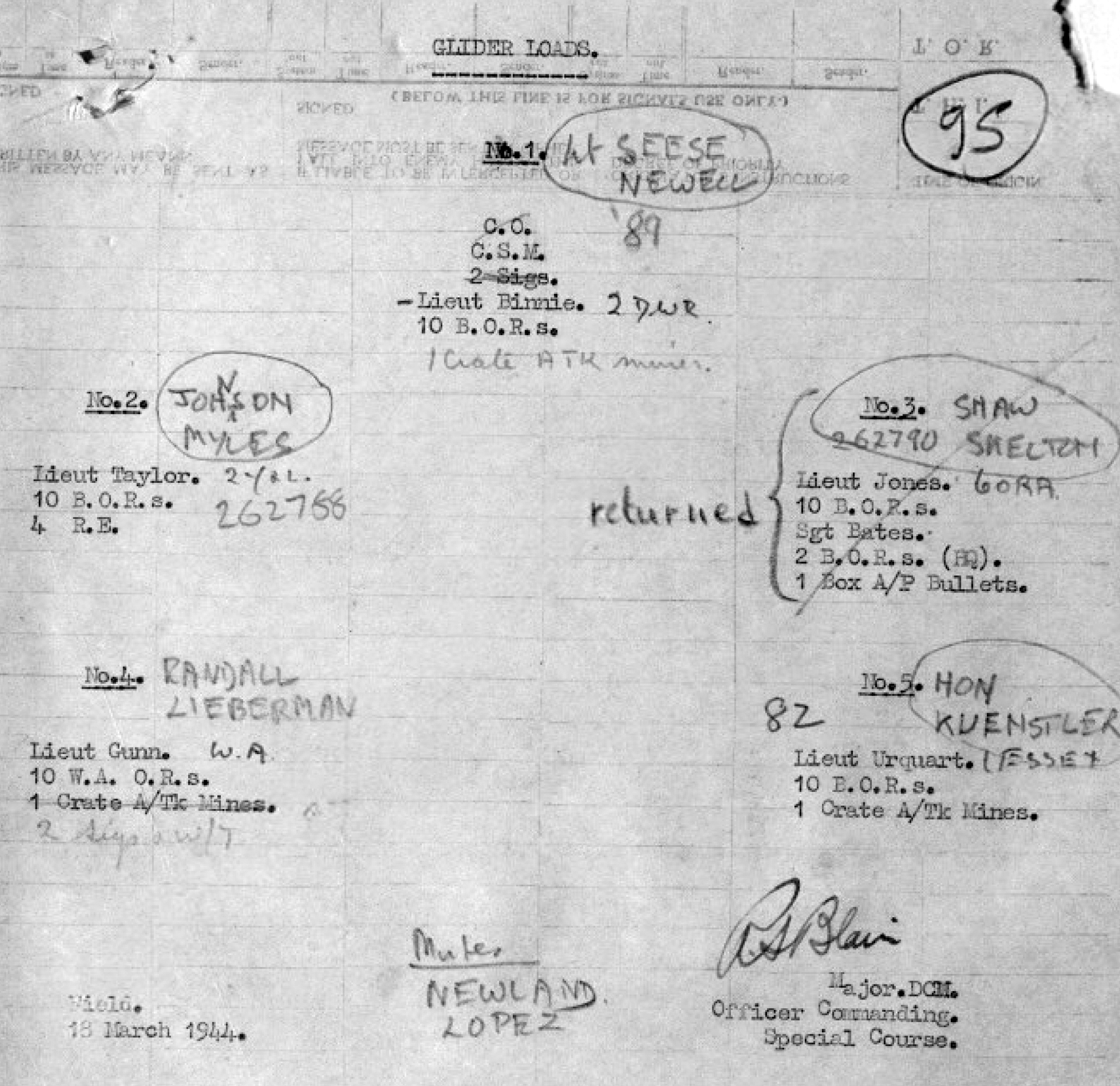
On completion of their objectives, Lt. Binnie led Bladet Force away from the railway and forcemarched his men on average 20 miles a day north towards the Aberdeen stronghold, where they were eventually flown out by Dakota aircraft to Shillong in India. On this long march out, they were ambushed on one occasion by a Japanese patrol with one man wounded. By the time they reached India, the party was both exhausted and malnourished after six weeks on operational duty in Burma. All men were hospitalised with many suffering from malaria as well as other diseases such as dysentery. On this subject, Pte. Brownhill’s daughter, Jane Hudson remembered: “My father told me, that when he arrived back at camp he was told to go to the hospital, but he said all he needed was a cup of tea. He also said that he could step out of his Army shorts and they just stood up as they were so filthy and all covered in mud!”
Pte. Brownhill’s service records show that he left the concessional (combat) area on the 27th July 1944 and returned to his unit, the 2nd Yorks & Lancs. After a period of leave, he was attached to Support Company - Special Force, before being posted to the 44th Indian Airborne Division in May 1945.
NB: It is known that after recuperating from their first mission on Operation Thursday, Lt. Binnie and the Lifebuoy flamethrower detachment from Bladet Force joined 77 Brigade at Mogaung and were involved in the expulsion of the Japanese from the village of Naungkyaiktaw on the 18th June.
In conclusion, Steven Brownhill had these further recollections of his father: “In keeping with many ex-servicemen from the war, my father didn’t want to discuss his time in the military and our mother would discourage us from asking him about his involvement in WW2. I remember in the early 1960’s when Sunday afternoon television seemed to always show a war film, my father would invariably exit the room. I once asked my mother why my father didn’t go to the cinema…. the answer was: “Because it reminds him of the jungle.”
“In later life he would occasionally make odd comments about Burma, but it wasn’t until the 1990’s that he became more forthcoming. One of the catalysts for this was the 50th anniversary of the ending of WW2 and a desire to have his WW2 medals. I asked my father why he had waited so long to obtain his medals? His response was: “they knew where I lived, so they could have posted them to me.” After applying to the Medal Office, in March 1998 the four medals duly arrived by post. My father sadly passed away on the 2nd August 2008, aged 93. As a way of keeping his WW2 service recognised, we have decided to donate his Army badges, orange silk escape map and other related items to the Kohima Museum in York.”
 Postscript: Since his first contact with the Chindit Society back in October, Steven Brownhill has now visited the Kohima Museum in York and the Rotherham Archives at Clifton Park Museum. In the search room at Clifton Park, he was able to access many documents in relation to the 2nd Battalion, The Yorks & Lancs Regiment. These included, the battalion war diaries for 1943 and 1944, more information about Bladet Force, more specific reports on Chindit operations in 1944 and his father listed on a nominal roll for the 2nd Yorks & Lancs’ two Guerilla Platoons. The Society would like to thank Steven for his efforts in collecting these documents together and for sharing them with us. Image seen to the left is Pte. Mons Brownhill’s Yorks & Lancs cap badge.