
Author
Jeremy Archer
Branch
Army
Personal Stories
I met Ken Embleton at The Not Forgotten Garden Party at Buckingham Palace on Tuesday 19 May 2026. We agreed that we would catch up later and duly did so on the ’phone five weeks later. I asked him about the Garden Party: "It was quite chilly: I had a blanket up to my ears; I don’t know how the ladies managed in their thin dresses. I had a nice chat with the Princess Royal – she ought to be Queen really." 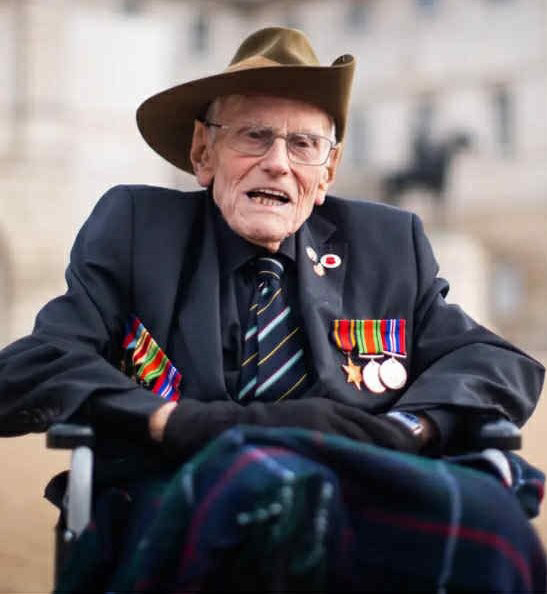 Apart from feedback on his day, my real purpose, wearing the hat of a Trustee of the Burma Star Memorial Fund, was to find out more about his wartime experiences, about which we spoke for almost two hours.
Kenneth (Ken) Robert Embleton was born on 4 June 1924 and baptised at St. Mark's, Kennington on 3 August 1924, only child of Stephen Edward Embleton and his wife Winifred Josey (nee Edgar). His father was a printer’s engineer with Arnold Goodwin & Sons of Sumner Street, Southwark and the family lived initially in Bramah Street, North Brixton before moving to 359 Hatfield Road, St. Albans, Hertfordshire. Ken told me that his paternal grandfather was very patriotic and that one of his uncles, Baden Powell Mafeking Embleton, was born on 18 May 1900, the day after the 217-day Siege of Mafeking was finally brought to a successful conclusion. On the same theme, he continued: "He was fond of names generally and if he liked someone he used to use their name. They dined regularly at a restaurant owned by someone called Pasqualino so another of my uncles was called Pasqualino – he very cleverly changed it to Patrick."
Ken continued: "I went to St. Albans School, which was at that time a minor public school, on a County Council Scholarship. It made a man out of me, I can tell you, and Cambridge did the rest. The Headmaster nearly had a heart attack when I got a State Scholarship to Queens’ College, Cambridge. He and my form tutor both thought of me as a sportsman, which I was, but I was an only child and therefore had plenty of time to learn all the school syllabuses. Although I started by reading English, I didn’t want to be a teacher or a civil servant so I eventually switched to law. One day, the Senior Tutor called me in and said that my reservation was no longer valid because they were taking it away from anybody who was not doing a subject that had something to do with the war – and Byron, Keats and all that stuff had nothing to do with the war! So I went down to the Recruiting Office where I was handed a piece of paper confirming that I had served with the Queen’s Royal Regiment for a day, together with a five-shilling bounty. They also told me that I must now serve with the University Officer Training Corps [UOTC], which I did – and I enjoyed it.
"I carried on with my English studies until I was called up. As 6108205 Private K.R. Embleton I was sent to the Primary Training Wing of the Sherwood Foresters in Lincoln, where we did all sorts of damned stupid things. I had a Cert ‘A’ from school and a Cert ‘B’ from the UOTC but they took no notice of any of that. After attending a WOSB [War Office Selection Board] at Catterick, I became an officer cadet at 150 OCTU [Officer Cadet Training Unit], which was also at Catterick, then the home of the Royal Corps of Signals, before it moved to Blandford. On 6 June 1944, we were all on parade with officer cadet’s white collar tabs and polished boots when we heard that the invasion of Europe had begun. After I was commissioned [on 1 November 1944] I fully expected to be a reinforcement in Europe; however, someone in the War Office decided that I should go to India instead. Life had come full circle: we once lived in Bramah Street, named after the Hindu god of creation, my father used to attend the Baroda Club in South London, funded by the wealthy Maharaja of Baroda, and now I was off to India!
"In February 1945, as soon as I got off the S.S. Otranto in Bombay, I was given a copy of ‘Learn Urdu in Six Pages’, before being posted to the 14th Army in Burma. Can you imagine it? We were all part of a draft and, after being taken to the railway station, we boarded a train to Mhow, which I think is still the home of the Indian Army Corps of Signals. The windows of the train had no glass but there were bars across the opening. Shortly after we departed a body landed on the step-board outside the window and, shortly afterwards, a male Indian arm appeared, holding a fearsome-looking dagger. I thought to myself: ‘What am I doing here if they don’t like us?’ We all shrank to the back of the compartment and he fortunately missed us. As we picked up speed, he eventually dropped off. I was forced to change carriages by an Indian Army major and found myself sitting next to a member of the Congress Party, with a white fore-and-aft cap. We had a good chat together until he said: ‘We’re getting on well but we don’t want you in this country.’ Having reached Mhow safely, four of us were picked up by trucks in the good old military way and were taken to the Officers’ Mess, where I was allocated a very imposing bearer who wore a silk turban of many colours. He once said to me: ‘Why is it that white men in the morning want to sit in dirty water?’ In the typical Army way, we were told that we hadn’t been expected till next year – you know the sort of thing. I went to the stables and rode a horse for an hour or so but that was quite enough.
"Then it was back on the train for the three-day journey to Calcutta. During breaks, we used to camp on our kit in the rest rooms. In Calcutta, we waited for a taxi, which was an open sedan, driven by a wild-looking Sikh. While we waited for the next posting order, we stayed in the Grand Hotel, which was an officers’ staging post. To our surprise, the Grand Hotel was on the outer limit of the operational area, which meant that people serving there qualified for the War Medal; on the other hand, the Burma Star was prized because you had to be facing the enemy in order to receive one. The American Army had arrived in force and they used to get all the girls with all the cosmetics they had brought with them. I then received an order: ‘Proceed directly to Dimapur’. Soon I was on a boat on the Brahmaputra and then on a train, rattling my way up to the war zone, to Dimapur, the rear depot. I reported to the Camp Commandant, who said: ‘I’ll put you down for the next flight. Have you seen the Chief Signals Officer [CSO] yet?’ The CSO asked me lots of questions: ‘What do you want to do? What are your skills? What do you like?’ After I explained that I wasn’t good at valves but enjoyed building lines, he said: ‘Good show! I think that there’s something here for you.’
"We then waited around for a full plane, which was going to fly us to Meiktila, except that there was a battle going on there, you know. The Camp Commandant said: ‘The 14th Army is short of soft-skinned vehicles but we’ve got plenty here so those of you who can drive can choose one.’ I selected a Willis Jeep, which was very, very neat. I drove via Kohima and Imphal, which looked just like those First World War views of the Somme, with shattered trees. When I eventually arrived at Schwebo, the Logistics Sergeant first looked at my warrant and then looked at me, before saying: ‘You’ll be in command of 40 Punjabis. They were in the desert and they’re very, very experienced.’ So there was I, straight off the ship, in charge of these veterans. Officially, I was OC 223 Lines of Communications Section. They had initials: I was in ‘H’ to begin with and was then posted to ‘R’ for the invasion of Malaya. I was a War Substantive lieutenant with a jemadar, a Viceroy Commissioned Officer, as my second-in-command. Every time I gave an order the soldiers would look at my jemadar to see if they should carry it out. Fortunately, I managed to find a promotion for him, which not only pleased him but also made life easier for me because I didn’t have the same problems with his replacement. Nevertheless, the fact that I had a jemadar at all blocked my progress otherwise I would have been a captain. So I was slowly learning the trade of the unit I was in command of.
"I was asked to sign off on a peacetime manifest: two batmen, three cooks, four labourers, two ‘untouchables’ and lots of soldiers who climbed up posts and did things. The ‘untouchables’ remained quite separate and did terrible jobs like digging latrines. I remember them having to jump into a Japanese latrine in order to clear it out. It was all a bit lonely: while they exchanged news from their villages, I ate British food on my own. Actually, it was a very important job because Slim, being a soldier’s soldier, wanted to get to Rangoon before Mountbatten, who was coming in by sea. The orders I received from my company commander, who wanted to stay with the main body, were to establish the communications for the defensive perimeter for the brigade which was sent on ahead to cut the road from Mandalay to Rangoon. With the 15th Japanese Army on one side and the 55th Japanese Army on the other, we took a chance and were, quite literally, the ham in the sandwich. The information flow was nothing like we had been taught at OCTU. There was little of ‘Information’, ‘Intention’, ‘Report’, etc.; instead, there were maps covered with chinagraph markings: blue was us and red was the enemy. Although it was all very hit-and-miss, the two armies didn’t join up but continued to retreat eastwards and Rangoon was abandoned. After the capture of Rangoon, I was told: ‘All your vehicles have been waterproofed and your troops had better get going in the assault craft. We were in Rangoon Harbour and Operation Zipper, the landing on the Malayan coast, was about to begin. I was just about to get on the assault craft with my men when the Japanese surrendered. We didn’t know why but we were all very pleased about it. If we had gone there in hot blood, it would have been a complete disaster. We later learned that our objective was honeycombed with tunnels and bunkers. Having been discharged to the Reserve as a ‘Z’ man in 1946, I got a ‘B’ release which meant I got early release because I was doing a degree.
"In 1951, I had only just qualified as a lawyer when I received a little brown envelope calling me up for ‘destination unknown’. The Information Signal Regiment was mustering at Oswestry: there were a lot of ‘Z’ men who didn’t want to be there and my job was to knock them into shape – which I did. We were to be the ground connection with the Royal Air Force. It probably saved my life when the Second Air Force was stood down and replaced in Korea by the Royal Naval Air Service. So we then went on leave but I was never called back – so I’m still on leave. My first job as a lawyer was in the City of London but I didn’t much like it so I joined E.T. Ray & Co. (Solicitors) of Church Square, Leighton Buzzard, Bedfordshire."
On 23 September 1948 at Crosby in Lancashire, Ken married Dorothy Mary, only daughter of William Francis Malone, paper merchant, of 27 Glenwyllin Road, Crosby and his wife Dorothy Emma (née Boardman). She had been awarded a Bachelor of Arts degree in English by University College London that same year and died from cancer in October 1986, leaving a daughter. After Dorothy’s death, Ken married Pat Tunnell, who also died of cancer. He married for a third time, to Oonagh, widow of Pat Colbeck: they once lived in Leighton Buzzard but emigrated to Australia as ‘Ten-pound Poms’. After Pat’s death, Oonagh visited her sister in England, reconnected with Ken and they married and lived together in Swanage for 15 years. Although she’s still alive, she has vascular dementia and is being cared for by her family in Adelaide.